You assess.
The report writes itself.
The clinical assistant built for occupational therapists. Delta organises case histories, incorporates your observations, and drafts your occupational therapy assessments and reports. Every assessment stays linked to the patient's follow-up.
bathroom not adapted · high step · transfers partially independent
Your documents, written in your style.
Reports, letters, supporting letters: Delta drafts them from your sessions. You review, adjust, and export.
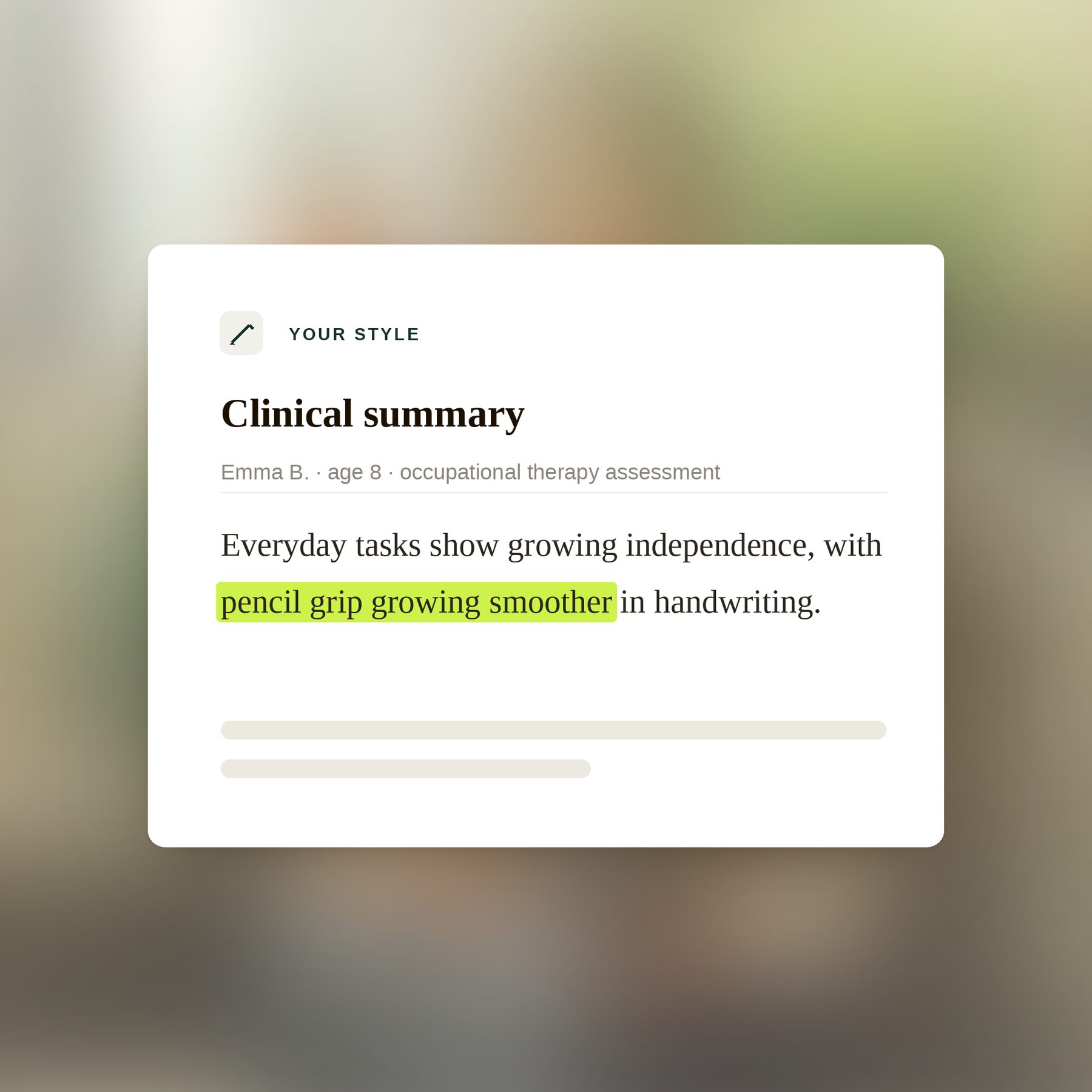
Written in your style
Delta learns the way you write. The more you use it, the more the output sounds like you.
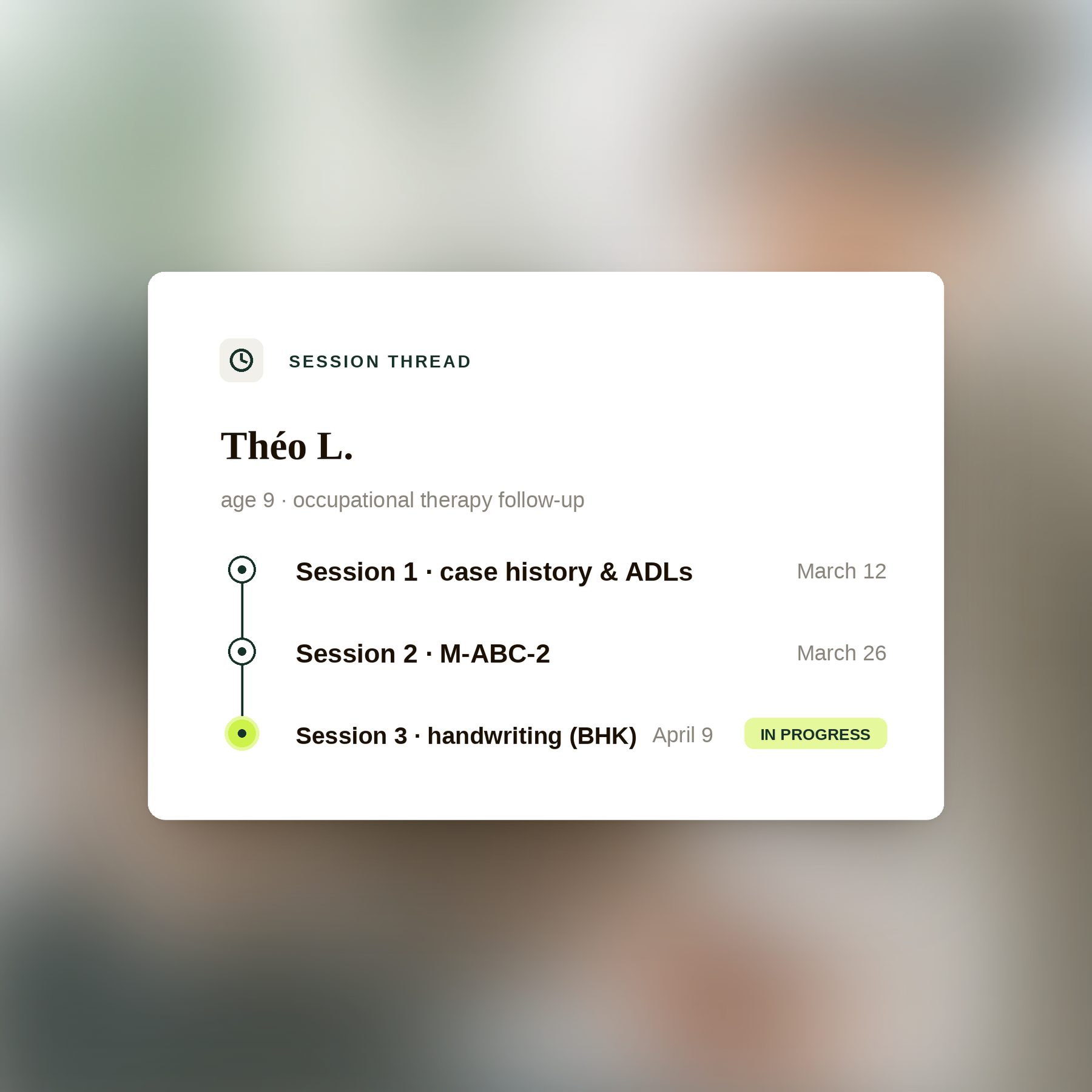
Across the full history
Every report draws on the patient's entire session history, not just the last one.
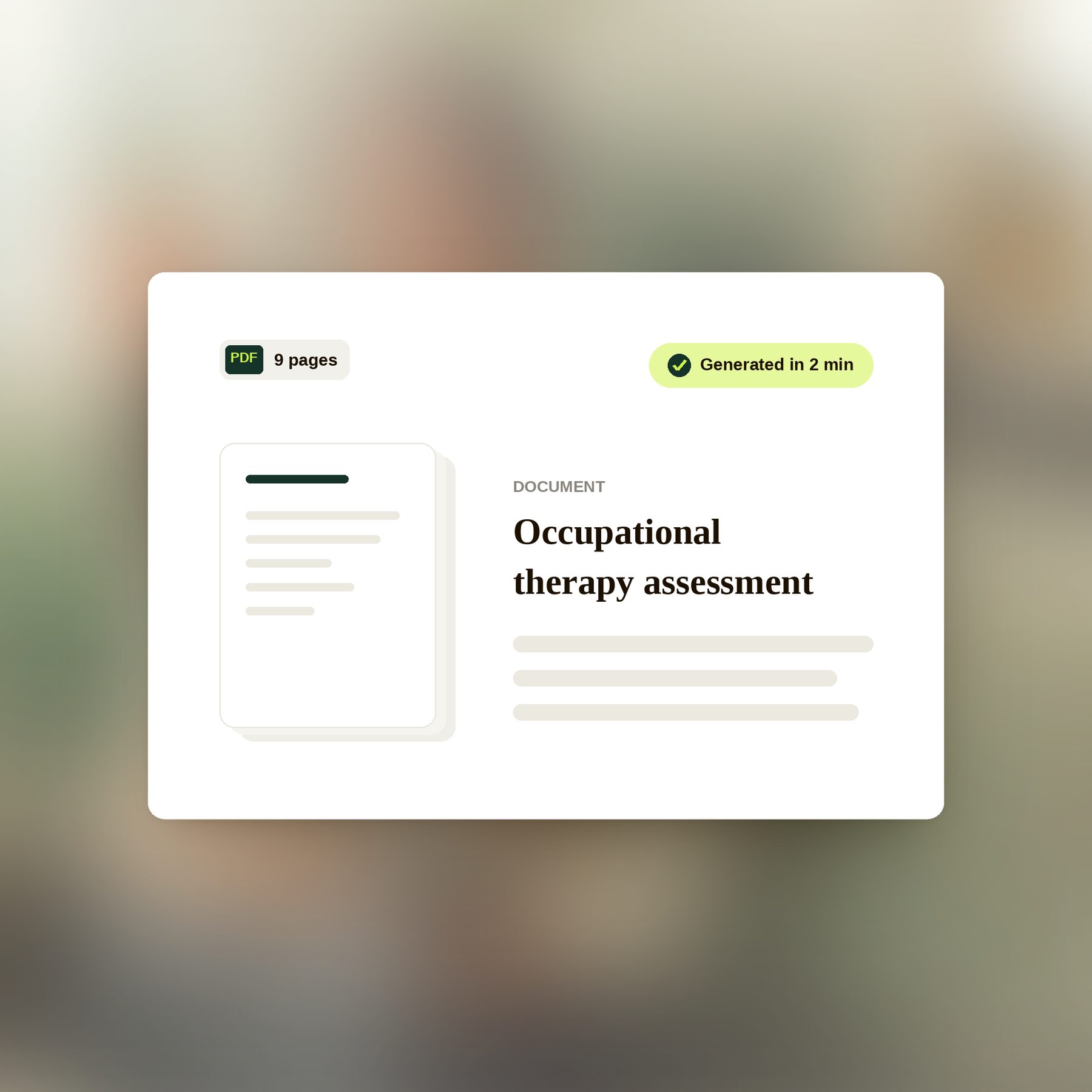
Hours saved
Several hours saved on every assessment. You review, adjust, and export.

"My assessments used to eat up my weekends. Now I observe during the session, Delta drafts the report, and I review it. I've got my evenings back."
During the assessment, or right after.
Your report is ready.
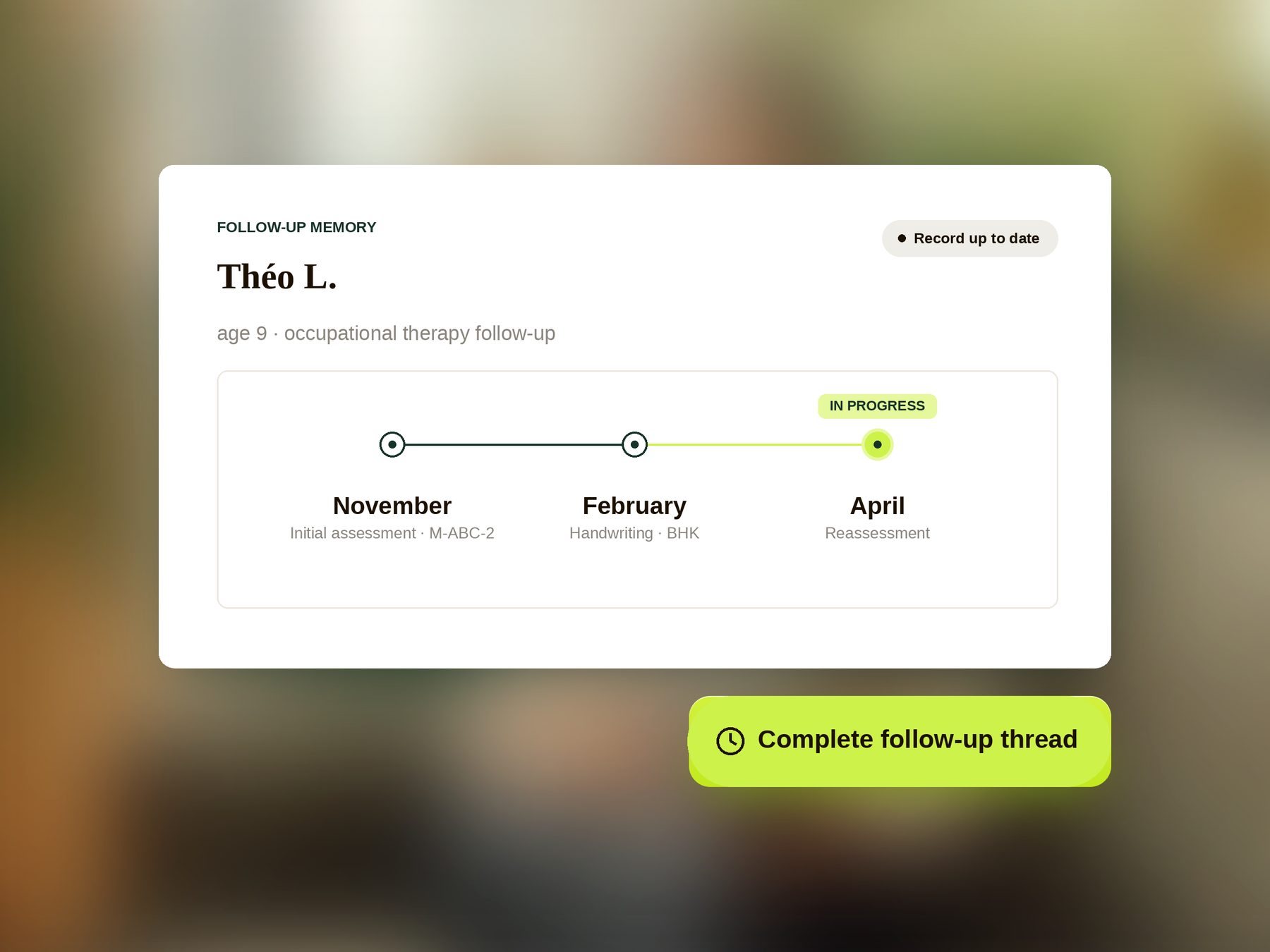
Arrive prepared for every session.
Case history, tests already administered, past results: the patient's complete file, always up to date. You ask, Delta answers in seconds.
It's not just about saving time.
It's a lighter mental load.
Your sessions train no AI.
Zero training. Your patient data is used only for you, never to improve a model. It's our most important commitment, because that's what you owe your patients.
Questions we get from occupational therapists.
Everything you need to know before you get started.
EN
Does Delta adapt to my occupational therapy practice?
Yes. Delta provides templates for the main documents occupational therapists write: occupational therapy assessment, ADL assessment (activities of daily living), sensory assessment, fine motor and handwriting assessment, reports, recommendations, and letters. You can also create and customise your own templates to match your practice. The AI adapts to your clinical vocabulary.
Does Delta replace my current note-taking tool?
Delta goes further than standard transcription tools. Where most simply summarise a single session, Delta links each consultation to the previous ones and generates all your clinical documents: session notes, case histories, assessments, referral letters, end-of-care reports, supporting letters.
In practice, you no longer juggle a notes tool + a patient file + a letter generator: Delta does all three, plus longitudinal clinical memory. Most of our users arrive with a notebook, a Word file, or notes typed between two patients.
Does Delta replace my practice-management software (calendar, billing)?
No, and that's intentional. Delta focuses on the clinical and documentation side: session notes, reports, letters, patient memory. Your calendar, appointment booking, and billing stay on the tool you already use (Doctolib, your practice-management software…).
Delta works alongside these tools, it doesn't replace them: you get every document in one click (copy-paste, PDF, structured export) to file wherever you like. No migration required, no double data entry.
Does Delta make diagnoses or decisions on my behalf?
No. Delta is a documentation and drafting tool: it formats what you observe and decide, in your style. It never makes a diagnosis, never interprets scores, and never substitutes for your clinical judgment: you score, you interpret, you decide.
The evidence from the literature that Delta can display is purely informational: food for thought, never prescriptive recommendations. The clinical decision is always yours.
Does Delta score or calculate results on my behalf?
No. Delta never calculates a score: scoring, test selection, and result interpretation remain entirely yours. That's your expertise, and Delta isn't meant to replace it.
What Delta does is take the results you have scored and your assessment observations, then incorporate them into the report using your template and your style. You enter or dictate your scores, and Delta formats them into the document. You save drafting time, not clinical time.
Do I need to inform my patients? And how?
Yes, informing the patient is required under GDPR. Article 9.2.h of the GDPR provides for the processing of health data by a professional bound by confidentiality, which is the case for you. On that basis, written consent is generally not required. You remain the data controller, so it is for you to judge what your own practice calls for.
In practice, Delta provides you with an information poster to display in your office or waiting room, stating that you use Delta so you can focus fully on your patients. This is the approach taken by the leading tools on the market.
If you'd like to go further, you can mention Delta verbally at the start of the first session: some practitioners prefer this direct transparency. The patient can always decline: in that case, you take your notes manually as before. Delta remains entirely optional, session by session.
Do my notes stay confidential from my patients?
Absolutely. Your session notes are strictly private, intended solely for your clinical use. Patients have no direct access to them. If a patient asks to see their file (GDPR right of access), it's up to you to decide what you share: Delta never does this automatically. Professional confidentiality is fully respected.
Can I use Delta for teleconsultations?
Yes. Delta works just as well in person as in teleconsultation. Audio can be captured through your computer's microphone, your video-consultation tool (Doctolib, Livi, Qare, etc.), or your phone. It is automatically deleted as soon as transcription is complete.
Does Delta respect patient confidentiality and the code of ethics for occupational therapists?
Yes. Delta is designed with full respect for the code of ethics and patient confidentiality of occupational therapists. The patient (or their legal representative) is informed that Delta is used during the session (Delta provides an information poster and a sample verbal notice) and can decline this at any time, in that case, you take your notes manually, session by session. Professional confidentiality is preserved, data is hosted in France with an HDS-certified host, and you keep full control over what is kept or deleted.
How does Delta support clinical supervision?
Delta helps you prepare for supervision sessions: you can generate an anonymised summary of a clinical case in one click, with the structured history, progress, and your questions. You never start from scratch the night before a supervision session again.
Can I import my old patient records?
Yes. Delta lets you import your old records (Word notes, PDFs, or manual entries) so your clinical memory starts with your existing history. We help you with this step for free when you upgrade to the Pro plan.
What happens if I stop using Delta? Can I get my records back?
Your records belong to you. At any time, you can export all your notes, reports, and case histories as PDF or structured format (JSON). After cancellation, you have 90 days to retrieve your data before it is permanently deleted.
No technical lock-in: your documents remain readable outside Delta, and your clinical memory can be re-imported elsewhere if needed.
Does Delta work for all my patient populations (children, adults, older adults)?
Yes. Delta provides templates adapted to pediatric occupational therapy (learning difficulties, fine motor skills, handwriting), adult rehabilitation (ADLs, reablement, assistive devices), and geriatrics (independence, home adaptations). You choose the template that fits your patient, and the AI identifies the different speakers in your notes (patient, parent, caregiver).