Home adaptation recommendations: the occupational therapist's approach
Home adaptation recommendations by the occupational therapist: the approach, the impairment→solution link, and funding (MaPrimeAdapt', PCH). Template to download.
Countries covered : France
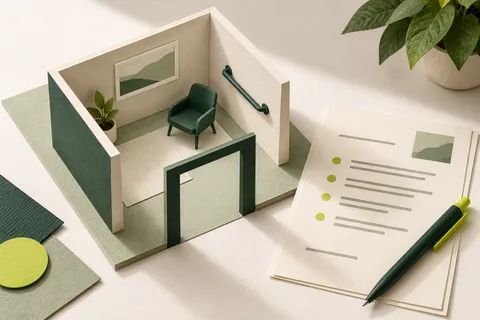
Adapting the home is one of the most effective ways to promote independence, provided that each solution addresses a specific difficulty. The occupational therapist assesses, links impairment to solution, and formulates reasoned recommendations that also help secure funding.
This page details the approach, the structure of the recommendations, and the available financial aid, with a template to download.
The principle: linking impairment to solution
The approach
- The home visit. Observing the person in their real environment and daily activities.
- The analysis of disabling situations. Identifying where and why independence breaks down (impairment × environment).
- Recommendations. Assistive technology, adaptations, space reorganization, with each solution linked to a difficulty.
- The written report. A reasoned and costed document, usable by contractors and funders.
The structure of a recommendation report
- Identification and context. Individual, potential prescriber, living situation.
- Independence assessment. Activities, environment, situations where independence breaks down.
- Recommendations by room / activity. Difficulty → solution → justification → estimated cost.
- Prioritisation. What is essential, what is desirable.
- Possible funding. Schemes to mobilize depending on the situation.
- Conclusion and next steps. Next steps (quotes, AMO, application submission).
Recommendation template to download
"Difficulty → solution → justification → cost" report, ready to fill in. Access the PDF by entering your email:
Save time on writing
Going over each difficulty, linking it to a costed solution, and structuring the report takes time. Start with a fixed template, standardise your recommendation wording, and dictate your observations right after the visit.
This is what Delta does: you capture your observations through live note-taking or post-visit dictation, and the tool generates a structured report based on your template, with longitudinal patient memory from one assessment to the next. HDS-certified hosting, GDPR compliant.
Frequently asked questions
Does the occupational therapist decide on the works?
No. They assess, link each difficulty to a solution, and formulate reasoned recommendations; the decision and funding are up to the individual, the funders, and, where applicable, the MDPH.
How do you make a recommendation credible?
By explicitly linking each solution to an observed difficulty, and by justifying and costing it.
Is a home visit necessary?
Yes: it is what allows for observing the person in their real environment and identifying situations where independence breaks down.
Cut the time spent on your reports in half
Delta generates your recommendation reports from your live observations or dictation.
Try for free